
24 Aug Can a Bicycle Accident Attorney Increase Compensation?
A bicycle accident attorney can potentially increase the compensation available in an injury claim by identifying all recoverable losses, preserving evidence, finding applicable insurance coverage, challenging disputed fault, and negotiating from a position supported by documentation. No lawyer can guarantee a particular settlement or promise that representation will always produce more money.
For injured cyclists, however, the difference between the first insurance offer and the full value of a supported claim can involve much more than an emergency-room bill.
A serious bicycle crash may affect future medical care, income, earning ability, mobility, daily activities, and the value of the bicycle itself. Florida’s insurance and comparative-fault rules can make the claim even more complicated.
Attorney Kevin L. Sullivan II represents Florida accident victims and handles communications with insurance companies so clients can concentrate on their recovery. His current website reports more than $40 million recovered for clients and states that personal injury clients pay no attorney fee unless he wins their case.
Key Takeaways
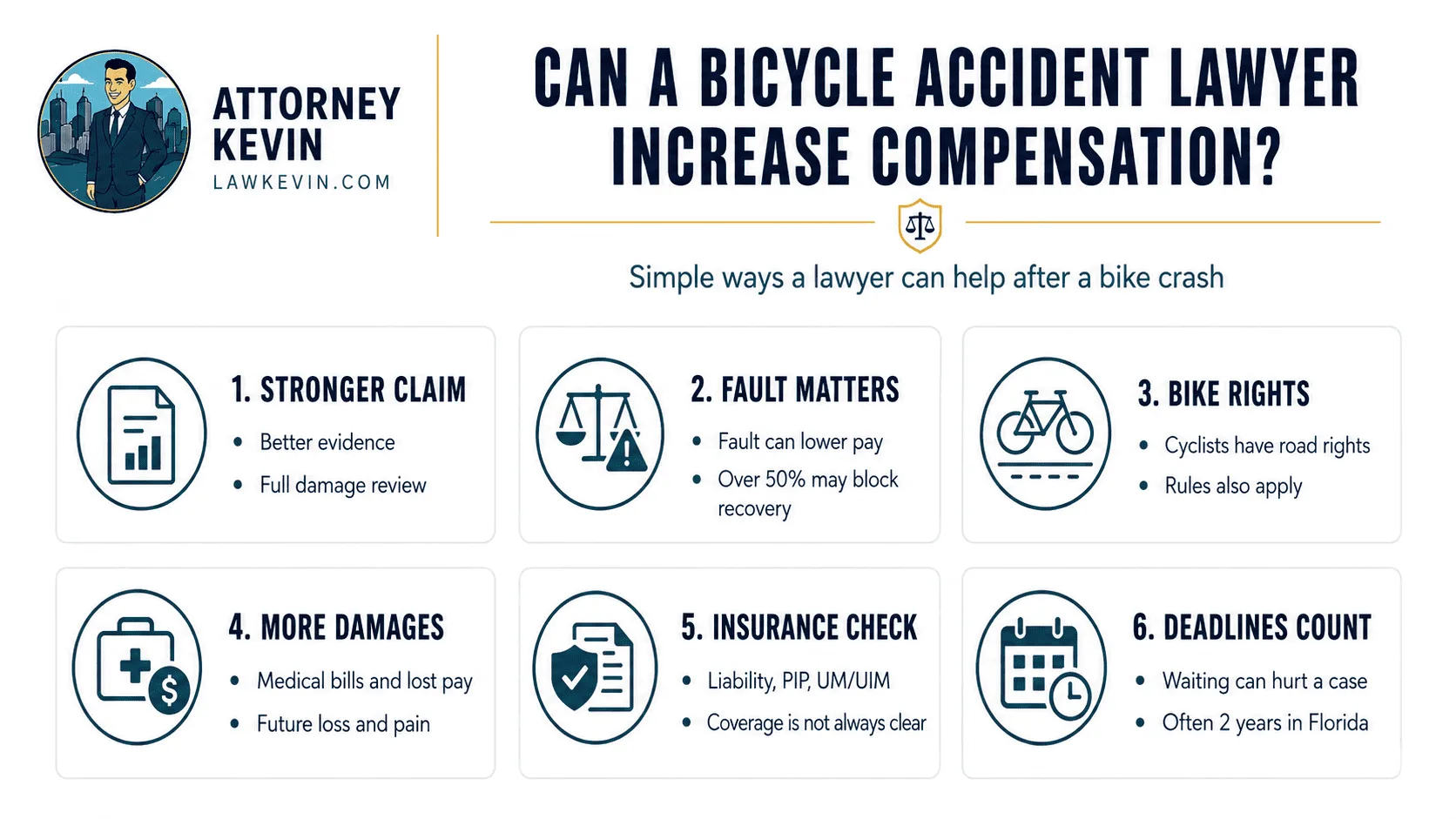
- A lawyer can strengthen the potential value of a bicycle accident claim. That usually happens through better evidence, more complete damage calculations, insurance-policy analysis, and negotiation—not by simply demanding a larger number.
- Florida’s comparative-fault law makes liability especially important. Compensation can be reduced according to a cyclist’s percentage of fault, and in negligence actions covered by the statute, someone found more than 50% responsible for their own harm generally cannot recover damages.
- Cyclists have legal rights and responsibilities on Florida roads. Florida law generally gives a person riding a bicycle the same rights and duties applicable to other vehicle drivers, subject to bicycle-specific rules.
- Available compensation may extend beyond current medical bills. Depending on the facts, a claim may involve medical expenses, lost income, future losses, property damage, and noneconomic harm.
- Insurance coverage is not always obvious. Depending on the crash and the cyclist’s policies, liability insurance, PIP, or uninsured/underinsured motorist coverage may need to be investigated. Florida law establishes both PIP provisions that can apply in certain motor-vehicle contacts and UM/UIM coverage rules.
- Waiting can create problems. Florida generally provides a two-year limitations period for negligence actions, although the exact deadline can vary with the circumstances.
Get a Free Consultation
Call us at (813) 598-4868
How Can a Bicycle Accident Attorney Increase Compensation?
A lawyer cannot change how badly someone was injured or create damages that do not exist.
What an attorney can do is make sure the claim reflects the losses that can actually be supported by the evidence.
Insurance claims are often resolved based on documentation. If future treatment, missed income, physical limitations, or another available policy is overlooked, those omissions can affect what is ultimately recovered.
A bicycle accident attorney can help prevent that by building the claim systematically rather than treating the accident as a simple exchange of medical bills for an insurance check.
1. Calculating More Than the Immediate Medical Bills
One of the easiest ways to undervalue a bicycle injury claim is to look only at expenses that have already arrived.
A cyclist may still need orthopedic care, physical therapy, additional imaging, surgery, follow-up treatment, medication, or rehabilitation. Severe injuries may also interfere with a person’s ability to return to the same job or work the same number of hours.
The financial impact may therefore continue long after the crash scene has been cleared.
A lawyer can gather medical records, employment documentation, and other evidence needed to evaluate the broader consequences of the injury.
The goal is not to inflate a claim. It is to avoid settling before the reasonably supportable impact of the accident is understood.
2. Preserving Evidence Before It Disappears
Bicycle accident evidence can be surprisingly temporary.
Nearby businesses may overwrite security footage. Witnesses become harder to find. Road debris disappears. Vehicles are repaired. The damaged bicycle itself may be thrown away or fixed before anyone documents the impact.
That can create a serious problem when the driver and cyclist tell different versions of what happened.
Useful evidence may include crash-scene photographs, witness information, surveillance or dash-camera footage, police reports, vehicle damage, bicycle damage, phone records where relevant, medical documentation, and roadway conditions.
The competitor content you supplied correctly emphasizes early evidence preservation. The stronger Florida-specific point is why that evidence matters so much: fault can directly reduce—or in some covered negligence cases eliminate—a claimant’s recovery under Florida’s modified comparative-fault statute.
3. Fighting Attempts to Put the Blame on the Cyclist
Bicycle cases often involve arguments about where the cyclist was riding, whether the rider was visible, who had the right of way, or whether traffic laws were followed.
Florida law does not treat cyclists as people who simply have to get out of the way of motor vehicles.
Under Florida Statute §316.2065, a person operating a human-powered vehicle generally has the rights and duties applicable to other drivers, subject to the bicycle-specific provisions in the statute. Florida law also establishes rules regarding bicycle lanes, roadway positioning, lighting after dark, sidewalks, and other riding conditions.
That does not mean the motorist is automatically at fault.
It means liability should be evaluated based on what actually happened and what the law required from everyone involved.
This becomes financially important because Florida’s current comparative-fault rule reduces damages according to the injured person’s share of responsibility. A claimant found more than 50% responsible in a negligence action covered by the statute generally cannot recover damages.
Even a 20% or 30% disagreement over fault can make a meaningful difference in a substantial claim.
4. Finding Insurance Coverage You May Not Know Is Available
Many injured cyclists naturally focus on the driver’s insurance company.
That may not be the only coverage worth investigating.
Depending on the circumstances, the attorney may review the driver’s bodily injury coverage, the cyclist’s own automobile policies, uninsured or underinsured motorist coverage, and other potentially applicable policies.
Florida’s PIP statute can also provide benefits in certain circumstances involving a person who is not occupying a self-propelled vehicle and is injured through physical contact with a motor vehicle. Which insurer has responsibility depends on the person’s insurance status and the facts of the crash.
Uninsured and underinsured motorist coverage can become important when an at-fault driver’s insurance does not fully cover the damages. Florida law generally requires UM coverage to be offered with qualifying bodily-injury liability policies unless it is rejected or lower limits are selected in writing.
Finding another applicable layer of coverage does not automatically increase damages. It may, however, increase the insurance resources available to pay a valid claim.
5. Documenting Lost Income and Reduced Earning Ability
A bicycle accident does not have to prevent someone from working permanently to create an income loss.
An injured cyclist might miss several weeks of work, use paid leave, lose overtime, turn down projects, or return with physical restrictions.
For self-employed people, calculating that loss can become even more complicated.
Tax records, pay statements, employer documentation, business records, and medical restrictions may all become relevant.
More serious injuries can raise another question: has the accident affected the person’s ability to earn money in the future?
That issue requires more than saying, “I can’t work like I used to.” It needs documentation connecting the injury to actual limitations and economic consequences.
A bicycle accident attorney can help identify what evidence is needed to support that part of the claim.
6. Accounting for Pain and the Effect on Daily Life
Not every loss comes with a receipt.
A bicycle collision can result in pain, scarring, mobility restrictions, sleep problems, loss of independence, or an inability to participate in activities the injured person previously enjoyed.
The significance of those effects depends on the individual injury and applicable Florida law.
Strong claims document those consequences rather than relying on generic descriptions of “pain and suffering.”
Medical records, treatment history, photographs, testimony, and evidence showing how the person’s daily life changed can help explain the human impact of the accident.
7. Evaluating the Bicycle and Other Property Damage
For many riders, the bicycle itself is not inexpensive.
A collision may damage the frame, wheels, components, cycling computer, helmet, clothing, lights, or other equipment.
More importantly, the damaged bike may also contain evidence of how the collision happened.
Do not rush to repair or dispose of it after a serious crash, particularly when liability is disputed. Photographs and preservation of damaged equipment can help document both property loss and the mechanics of the impact.
That is a practical issue many general discussions about maximizing compensation overlook.
8. Handling Insurance Company Communications
Insurance adjusters investigate claims on behalf of insurers. Their evaluation may include liability, medical treatment, prior conditions, policy coverage, and statements from the people involved.
An injured cyclist who is also dealing with medical care may not want to manage repeated insurance communications while trying to recover.
Attorney Kevin states that one of his commitments to clients is handling insurance-company communications so they can focus on getting healthy. His website also says clients receive his direct cell phone number.
Legal representation does not mean every insurer will suddenly agree with the claim.
It means the discussion can be handled by someone whose job is to evaluate the legal and financial consequences of what the insurer is proposing.
9. Reviewing Settlement Offers Before You Sign Away the Claim
A quick offer can be attractive when medical bills are accumulating and income has been interrupted.
The concern is timing.
If someone settles before the medical outlook is clear, later treatment or continuing limitations may not have been fully considered. Settlement agreements generally resolve the claim rather than leaving it open for additional demands every time another expense appears.
A lawyer can compare an offer against the documented damages, available coverage, liability evidence, future risks, and costs of continuing the case.
Sometimes settlement makes sense.
Sometimes further negotiation or litigation may be appropriate.
The important point is understanding what is being released before making the decision.
Can an Attorney Guarantee a Higher Bicycle Accident Settlement?
No.
There is no responsible way to guarantee that hiring an attorney will increase compensation by a certain percentage or produce a particular settlement.
Case outcomes depend on the severity of the injuries, proof of negligence, comparative fault, medical evidence, available insurance, damages, credibility, and many other facts.
The real value of representation is that an attorney can identify issues that an injured person might otherwise overlook and present the claim in a way that accounts for the full range of supportable damages.
That can improve the potential recovery without promising a result.
What Compensation Could Be Available After a Florida Bicycle Accident?
Depending on the facts and applicable law, compensation may address medical expenses, future treatment, lost earnings, reduced earning capacity, damage to the bicycle and related property, and qualifying noneconomic damages.
Not every category applies to every case.
Florida’s negligence statute specifically recognizes economic damages such as past and future lost income and medical expenses when applicable.
The amount ultimately recoverable can also be affected by insurance limits, fault allocation, and other legal issues.
That is why two bicycle crashes involving similar injuries can produce very different claims.
Can You Recover Compensation if You Were Partly at Fault?
Potentially, yes—but Florida’s current rule has an important limit.
Florida follows modified comparative fault for negligence actions covered by §768.81. If an injured cyclist is assigned some fault, recoverable damages are generally reduced proportionally. If that person is found more than 50% at fault, the statute generally bars recovery in covered negligence cases.
For example, assume a cyclist had $100,000 in recoverable damages and was found 20% responsible. The comparative-fault calculation would reduce the damages by that 20% share.
Real cases are more complicated, but the example shows why evidence about how the crash happened can have a direct financial effect.
How Long Do You Have to File a Bicycle Accident Lawsuit in Florida?
For many Florida bicycle accident claims based on negligence, the general limitations period is two years under the 2026 version of Florida Statute §95.11.
Do not assume every accident has exactly the same deadline.
Different rules can apply depending on when the crash happened, the type of defendant, the nature of the claim, wrongful death, governmental entities, and other circumstances. A lawyer should evaluate the specific deadline rather than relying solely on a general online rule.
There is also a practical reason to act earlier: evidence can disappear long before the legal filing deadline expires.
Do Florida Bicycle Accident Attorneys Charge Upfront Fees?
Many personal injury attorneys handle bicycle cases on a contingency-fee basis.
Attorney Kevin’s current website states there are no upfront costs or fees for his personal injury representation and that attorney fees are charged only if he wins for the client. It also advertises a free, no-obligation case evaluation.
Florida regulates contingency-fee arrangements, so clients should always review the written agreement and understand how attorney fees and case costs are handled before signing.
The Florida Bar’s consumer guidance explains that clients have rights regarding contingency fees, costs, settlement decisions, and the information provided at the end of a case.
When Is Hiring a Bicycle Accident Attorney Most Important?
Legal representation can become especially valuable when injuries are serious, liability is disputed, the insurer blames the cyclist, multiple parties may be responsible, available insurance is unclear, future treatment is expected, or the accident affects the person’s ability to work.
It may also make sense to speak with an attorney before giving detailed statements or accepting a settlement when you do not yet know the full medical consequences of the crash.
A consultation does not obligate someone to file a lawsuit.
It can simply provide a clearer picture of what the claim involves.
Get a Free Consultation
Call us at (813) 598-4868
Focus on Healing While Attorney Kevin Handles the Insurance Claim
After a serious bicycle crash, your priority should be getting medical treatment and rebuilding your routine—not spending every day arguing with an insurance company.
Florida personal injury attorney Kevin L. Sullivan II represents accident victims throughout the state and is currently a Shareholder at LeavenLaw. His official attorney profile confirms his Florida personal injury practice, and his personal website reports $40,000,000+ recovered for clients.
Attorney Kevin offers a free, no-obligation consultation, handles insurance-company communications for his clients, and provides clients with direct access to him. His listed direct phone number is (813) 598-4868.
There is no attorney fee unless he wins your case, according to his current website. Results depend on the individual facts of each claim, and past recoveries do not guarantee a future outcome.
If you were injured while riding a bicycle, getting the claim reviewed early can help you understand the available insurance, preserve important evidence, and determine what compensation the facts may support.
Accident? Call Attorney Kevin L. Sullivan II at 813) 598-4868 today.
Frequently Asked Questions About Bicycle Accident Compensation
Q: Can a bicycle accident attorney really get me more money?
A: An attorney may improve the potential recovery by identifying damages and insurance coverage that were overlooked, strengthening liability evidence, challenging comparative-fault arguments, and negotiating the claim. No attorney can guarantee that representation will produce a larger settlement in every case.
Q: What if the driver says the bicycle accident was my fault?
A: That does not decide the claim. Evidence and Florida traffic laws determine how responsibility should be evaluated. Cyclists generally have the rights and duties of other vehicle drivers under Florida law, subject to bicycle-specific regulations.
Q: What if the driver who hit me does not have enough insurance?
A: Depending on your coverage, uninsured or underinsured motorist insurance may be relevant. Florida law governs how UM/UIM coverage is offered and when it applies. An attorney can review the policies rather than assuming the at-fault driver’s policy is the only potential source of coverage.
Q: Should I keep my damaged bicycle after the accident?
A: Yes, particularly after a serious or disputed collision. The damaged bicycle can document property loss and may contain physical evidence related to the impact. Avoid repairing or disposing of important evidence before it has been documented.
Q: How much is my bicycle accident claim worth?
A: There is no reliable average value. Compensation depends on injuries, medical treatment, lost income, future needs, property damage, liability, comparative fault, available insurance, and other case-specific evidence.
Q: Do I have to go to court to receive compensation?
A: Not necessarily. Claims can resolve through insurance negotiations or settlement, while others require litigation. Whether filing a lawsuit makes sense depends on the evidence, offers made, applicable deadlines, and strategy for the individual case.
Get a Free Consultation
Call us at (813) 598-4868
5720 Gall Boulevard, Ste 4
Zephyrhills, FL 33542
27642 Cashford Cir, Suite #110
Wesley Chapel*, FL 33544
5006 Trouble Creek Rd, Ste 205
Port Richey*, FL 33652
Sorry, the comment form is closed at this time.