

14 Sep How an Auto Injury Lawyer Can Strengthen Your Claim
An auto injury lawyer can strengthen your claim by preserving evidence, connecting your injuries to the crash, identifying available insurance coverage, documenting your financial losses, responding to fault disputes, negotiating with insurers, and preparing the case for court when necessary.
That matters because an auto accident claim is rarely decided by one photograph, one medical bill, or one version of what happened. The strength of a claim often depends on how well the evidence fits together.
In Florida, timing can matter too. Personal injury protection rules generally require initial medical services and care within 14 days of the crash for PIP medical benefits, while many current negligence claims are subject to a two-year limitations period. Different circumstances can create different deadlines, which is one reason early case review can be valuable.
Key Takeaways
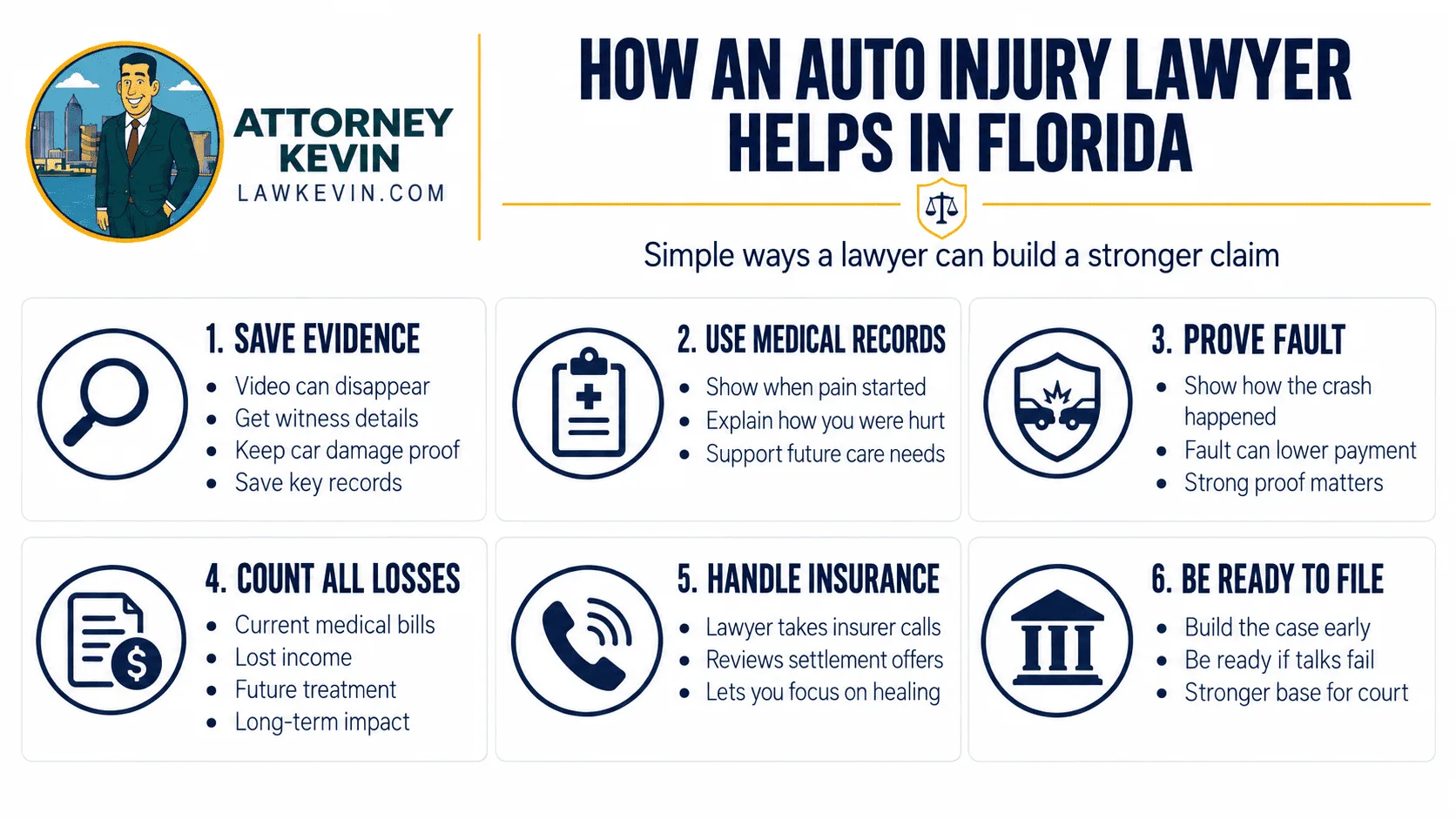
- An auto injury lawyer can preserve evidence that may disappear, including video, witness information, vehicle evidence, and other records.
- Medical records matter for more than proving that you were hurt; they can help establish when symptoms began, how the injury affected you, and whether future treatment may be necessary.
- Florida’s comparative fault rule makes evidence about how the crash happened especially important because a claimant’s percentage of fault can reduce or, in some cases, prevent recovery.
- A strong claim accounts for more than current medical bills. Lost income, future treatment, insurance coverage, and the long-term effect of an injury can also matter.
- An attorney can handle insurer communications and evaluate settlement offers while you concentrate on your medical recovery.
- Preparing a claim as though litigation may become necessary can create a stronger foundation if settlement negotiations break down.
Get a Free Consultation
Call us at (813) 598-4868
1. An Auto Injury Lawyer Preserves Evidence Before It Disappears
One of the first ways an auto injury lawyer can strengthen a claim is by finding and preserving evidence while it is still available.
Evidence changes quickly after a collision.
Vehicles are repaired. Skid marks disappear. Businesses overwrite surveillance recordings. Witnesses forget details. A damaged commercial vehicle may return to service. Photos and social media posts may be deleted.
Depending on the crash, useful evidence may include:
- Photographs and video from the scene
- Vehicle damage
- Florida traffic crash reports
- Witness names and statements
- Nearby security or traffic camera footage
- Dashcam recordings
- Cellphone or electronic records when legally relevant
- Vehicle event data
- Medical records
- Employment and wage records
- Insurance policies
- Maintenance or company records in commercial-vehicle cases
The evidence needed for a rear-end collision at a traffic light may be very different from what is needed after a multi-vehicle highway crash or an accident involving a commercial truck.
A lawyer’s job is not simply to collect as many documents as possible. The stronger approach is to determine which facts are likely to be disputed and then preserve evidence that helps answer those questions.
Evidence Becomes Even More Important When Fault Is Disputed
An insurer may accept that a crash occurred but disagree about who caused it.
Perhaps another driver claims you changed lanes unexpectedly. Maybe both drivers entered an intersection believing they had the right of way. In a multi-car collision, several drivers may point at one another.
These disputes can have significant consequences under Florida law.
Florida follows a modified comparative fault system for covered negligence actions. A claimant’s damages can be reduced according to the claimant’s percentage of fault. A party found more than 50% at fault for their own harm generally cannot recover damages in a negligence action covered by the statute.
That makes details such as vehicle position, impact points, witness accounts, video, and the sequence of events more than background information. They can directly affect the value and viability of the claim.
2. A Lawyer Helps Connect Your Injuries to the Accident
Proving that another driver caused a crash is only part of an injury claim. You also need evidence connecting the collision to the injuries and losses for which you are seeking compensation.
Medical documentation often becomes central to that issue.
Records may help establish:
- When symptoms began
- What injuries were diagnosed
- What treatment was recommended
- Whether symptoms improved or continued
- Whether work or daily activities were restricted
- Whether additional treatment may be necessary
- Whether an injury caused lasting limitations
The more complicated the medical history, the more important this connection can become.
What If You Had an Injury Before the Crash?
A pre-existing medical condition does not automatically mean a new accident caused no additional harm.
But it may give an insurer another issue to investigate.
For example, someone may already have had back pain before a collision and then experience significantly worse symptoms afterward. The legal and medical question becomes more detailed: what condition existed before the crash, and what changed because of the collision?
An auto injury lawyer can review prior and current medical documentation and work to distinguish the pre-existing condition from new injuries or aggravation when the evidence supports doing so.
That is far more useful than pretending the old condition never existed.
Early Medical Care Can Affect Florida PIP Benefits
Florida’s current PIP statute generally requires an injured person to receive initial services and care within 14 days after a motor vehicle accident for qualifying PIP medical benefits.
That 14-day rule is not the same thing as a deadline for filing every auto accident lawsuit, and missing it does not automatically determine every other legal claim arising from the crash.
It can, however, affect access to PIP medical benefits.
If you are injured, medical decisions should be based on your health and advice from qualified healthcare professionals. From a claims standpoint, timely records can also provide important evidence of what you experienced after the collision.
3. An Attorney Identifies Which Insurance Coverage May Apply
Finding the available insurance can be just as important as proving who caused the accident.
An injured driver may initially assume that the claim involves only the other driver’s insurance company. Some accidents are more complicated.
Depending on the circumstances and policies involved, potential sources of coverage may include:
- Personal injury protection
- The at-fault driver’s bodily injury liability coverage
- Your own uninsured or underinsured motorist coverage
- Coverage connected with an employer or commercial vehicle
- Policies covering additional responsible parties
- Other applicable insurance based on the facts of the crash
Florida law contains specific rules governing uninsured and underinsured motorist coverage. The coverage available in an individual case depends on the applicable insurance contracts, selections or rejections, and accident circumstances.
This becomes especially important when injuries are serious but the driver who caused the crash has limited insurance.
A claim may be strong on liability and damages but still face a coverage problem. Identifying that issue early helps determine what options should be investigated instead of discovering the problem after months of negotiations.
Multiple Responsible Parties Can Change the Claim
Some accidents involve more than two drivers.
Others involve:
- An employee driving for work
- A rideshare vehicle
- A delivery driver
- A commercial trucking company
- A vehicle owner different from the driver
- A defective vehicle or component
- Several drivers contributing to one collision
Those cases require more than asking, “Who got the ticket?”
An attorney can investigate the legal relationships between the people and companies involved and determine which potential claims are supported by the evidence.
4. An Auto Injury Lawyer Documents the Full Extent of Your Losses
A settlement should not be evaluated only by comparing the offer with the medical bills sitting on your desk today.
An accident may create financial consequences that develop over time.
Depending on the facts, damages may involve medical expenses, lost income, future lost income, and other economic losses. Florida’s comparative fault statute specifically recognizes categories including past and future lost income and medical expenses as economic damages.
A lawyer may review evidence involving:
Medical costs. Hospital care, physician treatment, rehabilitation, diagnostics, prescriptions, and other accident-related treatment can affect the claim.
Lost earnings. Time away from work may need to be documented through employment records, pay information, tax records, or other evidence.
Reduced ability to work. A serious injury may affect what a person can do in the future, even after returning to some form of employment.
Future treatment. If doctors expect additional medically necessary care, settling before that future impact is reasonably understood can make valuation harder.
Property-related losses. Vehicle damage and other accident-related property issues may also need to be addressed separately from the bodily injury component.
There may also be noneconomic damages in qualifying cases, but Florida places statutory restrictions on recovering damages for pain, suffering, mental anguish, and inconvenience arising from motor vehicle injuries.
Under Florida Statute §627.737, recovery of those noneconomic damages generally requires an injury meeting a statutory threshold, such as a significant and permanent loss of an important bodily function, permanent injury within a reasonable degree of medical probability, significant permanent scarring or disfigurement, or death.
An attorney can evaluate which categories may apply based on the evidence rather than assigning an arbitrary number to the claim.
5. A Lawyer Handles Insurance Company Communications
After a crash, you may hear from adjusters while you are still dealing with pain, medical appointments, transportation problems, missed work, and vehicle repairs.
An attorney can take over much of that claims communication.
At Law Kevin, one of our promises to clients is straightforward: Attorney Kevin deals with the insurance companies so you can focus on getting healthy. Our clients also receive Attorney Kevin’s direct cell phone number at (813) 598-4868.
Having legal representation does not mean every insurer request is improper. Insurance companies legitimately investigate claims, and an insured person may have obligations under their own policy.
The issue is making sure responses are accurate and handled with an understanding of how the information could affect the claim.
A lawyer can help review matters such as:
- Requests for statements
- Medical documentation
- Insurance forms
- Settlement releases
- Questions about prior injuries
- Fault allegations
- Requests involving wage loss
- Settlement negotiations
A seemingly simple question can become important if the parties later disagree about how the collision occurred or how badly someone was injured.
6. An Attorney Evaluates Settlement Offers in Context
An early settlement offer is not automatically a bad offer.
It is also not automatically a fair one.
What matters is whether there is enough information to evaluate it.
Consider the difference between two claims.
In the first, the injured person has completed treatment, returned to work, and has a relatively clear medical prognosis.
In the second, treatment is still ongoing, surgery is being considered, the person has not returned to the same job, and the insurer is disputing part of the fault.
Those claims should not be evaluated the same way.
An auto injury lawyer can compare an offer against the available evidence, coverage, medical situation, disputed issues, and likely costs and risks of continuing the case.
Why Settling Too Early Can Be a Problem
Personal injury settlements generally involve a release of claims.
Once a claim is fully settled and released, the injured person ordinarily cannot simply reopen it because medical problems later became more expensive than expected.
That makes unresolved medical issues important.
The objective is not to delay a claim unnecessarily. It is to understand what is being settled before giving up the right to pursue additional compensation.
7. A Lawyer Protects Deadlines and Procedural Requirements
Claims can involve several different clocks.
For example, Florida’s PIP rules generally use the 14-day initial-treatment requirement discussed above. Separately, Florida Statute §95.11 currently provides a two-year limitations period for actions founded on negligence.
The correct deadline can depend on factors including:
- When the accident occurred
- The type of defendant
- The legal theory involved
- Whether a government entity is involved
- Whether a death occurred
- Other circumstances affecting the claim
For that reason, accident victims should not assume that a deadline found online necessarily applies to their specific situation.
A lawyer can identify the relevant requirements and keep the case moving while evidence and legal rights remain available.
8. An Auto Injury Lawyer Prepares for Litigation Before It Becomes Necessary
Many personal injury claims resolve without a trial.
That does not mean litigation preparation should begin only after negotiations fail.
A stronger claim is usually organized from the beginning so the evidence can withstand closer scrutiny later.
That can mean documenting:
- Who was responsible
- Why the evidence supports that conclusion
- Which injuries resulted from the crash
- What treatment occurred
- How the injuries affected work and daily life
- What financial losses resulted
- What insurance is available
- Which factual or legal issues remain disputed
If negotiations do not produce an acceptable resolution, the attorney can evaluate whether filing a lawsuit is appropriate.
Litigation may then involve depositions, document requests, expert testimony, motions, mediation, and potentially trial.
The decision to file suit should depend on the individual case. The important point is that an insurer knows whether a lawyer is prepared to continue beyond a demand letter.
What Can Make an Auto Injury Claim More Complicated?
Some claims are relatively straightforward. Others develop several overlapping disputes.
An auto injury lawyer may become particularly valuable when the insurer is not simply questioning one issue but several at once.
For example:
Fault Is Contested
Florida’s comparative fault rules can make disputed liability especially important. Evidence showing how the accident occurred may affect both whether compensation is available and how much may be recovered.
Medical Treatment Is Still Ongoing
Future treatment and long-term limitations may not yet be clear. That can make an early settlement more difficult to evaluate responsibly.
You Have a Pre-Existing Condition
An insurer may argue that some or all symptoms existed before the accident. Medical documentation becomes important in separating prior conditions from accident-related changes.
Several Vehicles Were Involved
A chain-reaction collision may require determining the percentage of responsibility attributable to several drivers rather than identifying one obvious at-fault party.
The At-Fault Driver Has Limited Insurance
The legal value of the damages and the amount of collectible insurance are separate questions. Other coverage, including potentially applicable uninsured or underinsured motorist coverage, may need review.
You Cannot Return to the Same Work
The claim may involve more than wages already missed. Evidence about long-term employment limitations can become relevant when supported by the facts.
The Insurer Disputes the Severity of Your Injury
The fight may shift from who caused the crash to whether the collision caused the medical condition being claimed and how serious that condition really is.
These are the circumstances in which a case often requires more than submitting bills and waiting for an offer.
What Should You Do to Help Strengthen Your Own Claim?
Your attorney handles the legal work, but you still play an important role.
Be accurate.
Give your lawyer complete information about the crash, prior accidents, prior medical conditions, treatment, work history, and communications with insurers. An unpleasant fact discovered early is usually easier to address than a surprise discovered later.
Keep relevant records.
Save accident photographs, receipts, medical information, insurer letters, repair documents, wage information, and other materials connected with the collision.
Follow reasonable medical advice.
Your health comes first. Consistent records also make it easier to understand the course of an injury than unexplained gaps in treatment.
Avoid guessing.
If you do not know an answer, say that. A confident guess about speed, distance, timing, or another fact can create problems if later evidence shows something different.
Stay in contact with your lawyer.
Tell your attorney about changes in treatment, employment, contact information, insurance communications, or other developments that could affect the case.
Does Hiring an Auto Injury Lawyer Guarantee a Larger Settlement?
No. Hiring an auto injury lawyer cannot guarantee that a claim will succeed or that a particular amount will be recovered.
Every accident is different.
Fault, insurance limits, medical evidence, injury severity, prior health conditions, witness credibility, available records, and many other factors may affect the outcome.
What an attorney can do is improve how the claim is investigated, documented, valued, presented, negotiated, and—when appropriate—litigated.
That gives the claim a stronger factual and legal foundation.
Get a Free Consultation
Call us at (813) 598-4868

Let Attorney Kevin Handle the Claim While You Focus on Getting Healthy
After an accident, you already have enough to handle.
At Law Kevin, we help injured people understand their options while Attorney Kevin deals with the insurance companies and fights for proper compensation and payment of accident-related medical bills where recoverable.
Our promises to clients include:
- A FREE no-obligation consultation
- Direct access to Attorney Kevin at (813) 598-4868
- Attorney Kevin handling the insurance companies while you focus on getting healthy
- Advocacy aimed at obtaining proper compensation and getting medical bills paid
- No attorney’s fee unless you win
Law Kevin’s website states that there are no upfront costs or fees and that attorney’s fees are charged only if Attorney Kevin wins for the client. Specific fee and cost terms should always be reviewed in the written representation agreement.
If you have been injured in a Florida auto accident and have questions about your claim, call Attorney Kevin L. Sullivan II at 813) 598-4868 for a free, no-obligation consultation.
Frequently Asked Questions About Auto Injury Claims
Q: What does an auto injury lawyer do after a car accident?
A: An auto injury lawyer investigates the collision, preserves evidence, reviews insurance coverage, documents injuries and losses, communicates with insurers, negotiates settlement offers, monitors legal deadlines, and can file a lawsuit when appropriate.
The exact work depends on what is disputed in the individual case.
Q: When should I contact an auto injury lawyer?
A: It can be helpful to speak with a lawyer early when you are injured, fault is disputed, several vehicles were involved, the insurer is requesting information you do not understand, or your medical condition may have long-term consequences.
Early review can also matter when evidence such as surveillance video may disappear.
Q: Can I still have a claim if I was partly at fault for the accident in Florida?
A: Potentially. Florida law generally reduces damages according to a claimant’s percentage of fault. However, for negligence actions covered by Florida Statute §768.81, a party found more than 50% responsible for their own harm generally cannot recover damages.
The facts surrounding fault should therefore be investigated carefully.
Q: How long do I have to file a car accident lawsuit in Florida?
A: Florida Statute §95.11 currently provides a two-year limitations period for actions founded on negligence. However, the correct deadline can depend on the date and circumstances of the accident, the defendant, and the type of claim involved.
Do not wait until the deadline is approaching to investigate your specific case.
Q: Do I have to see a doctor within 14 days after a Florida car accident?
A: Florida’s PIP statute generally requires initial medical services and care within 14 days of the motor vehicle accident to qualify for PIP medical benefits.
That rule relates specifically to PIP benefits and should not be confused with the separate deadline for filing a negligence action.
Q: What if the insurance company already offered me a settlement?
A: You can have an attorney review an offer before accepting it. The key question is whether your injuries, future treatment, lost income, available coverage, and other losses are sufficiently understood to evaluate what you would be releasing.
An early offer may require additional scrutiny when medical treatment is still ongoing.
Q: How much is my auto injury claim worth?
A: There is no universal formula. Claim value can depend on fault, injury severity, medical expenses, future treatment, lost income, long-term limitations, available insurance, and other case-specific evidence.
Law Kevin’s own guidance likewise notes that every accident case is different and identifies factors such as fault, injuries, property damage, medical expenses, and the number of people injured as considerations that may affect value.
Q: Do I pay an attorney’s fee upfront at Law Kevin?
A: Law Kevin states that there are no upfront attorney’s fees and that attorney’s fees are charged only if Attorney Kevin wins for the client. The firm also offers a free, no-obligation consultation.
Get a Free Consultation
Call us at (813) 598-4868
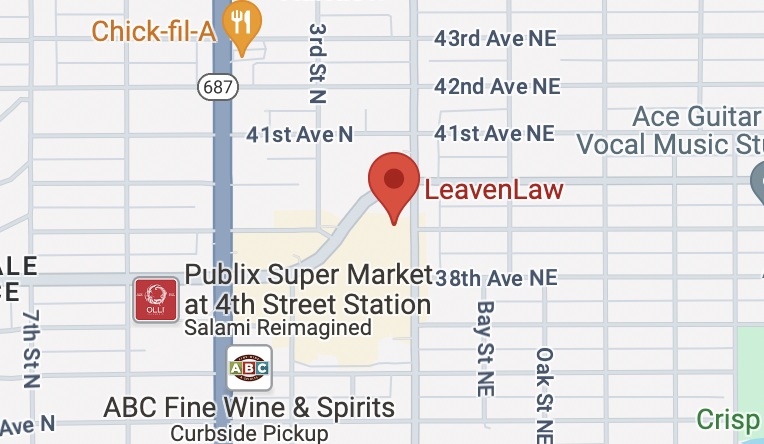
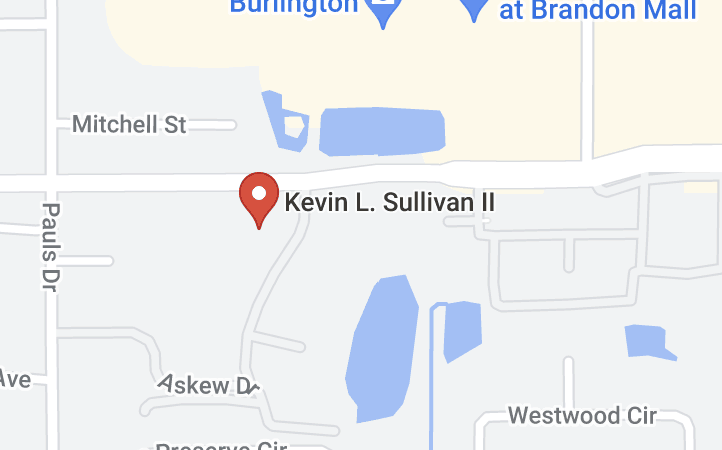
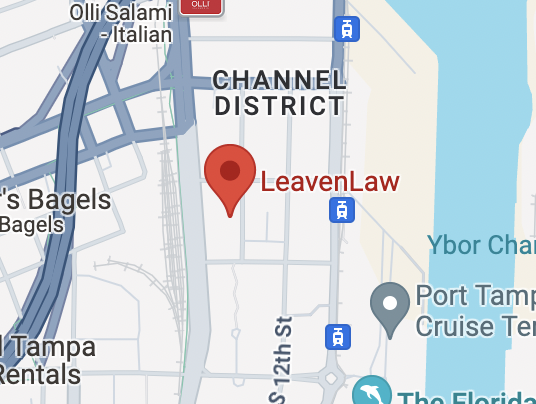
5720 Gall Boulevard, Ste 4
Zephyrhills, FL 33542
27642 Cashford Cir, Suite #110
Wesley Chapel*, FL 33544
5006 Trouble Creek Rd, Ste 205
Port Richey*, FL 33652
Sorry, the comment form is closed at this time.