

21 Sep How Much Does It Cost to Hire a Lyft Accident Attorney?
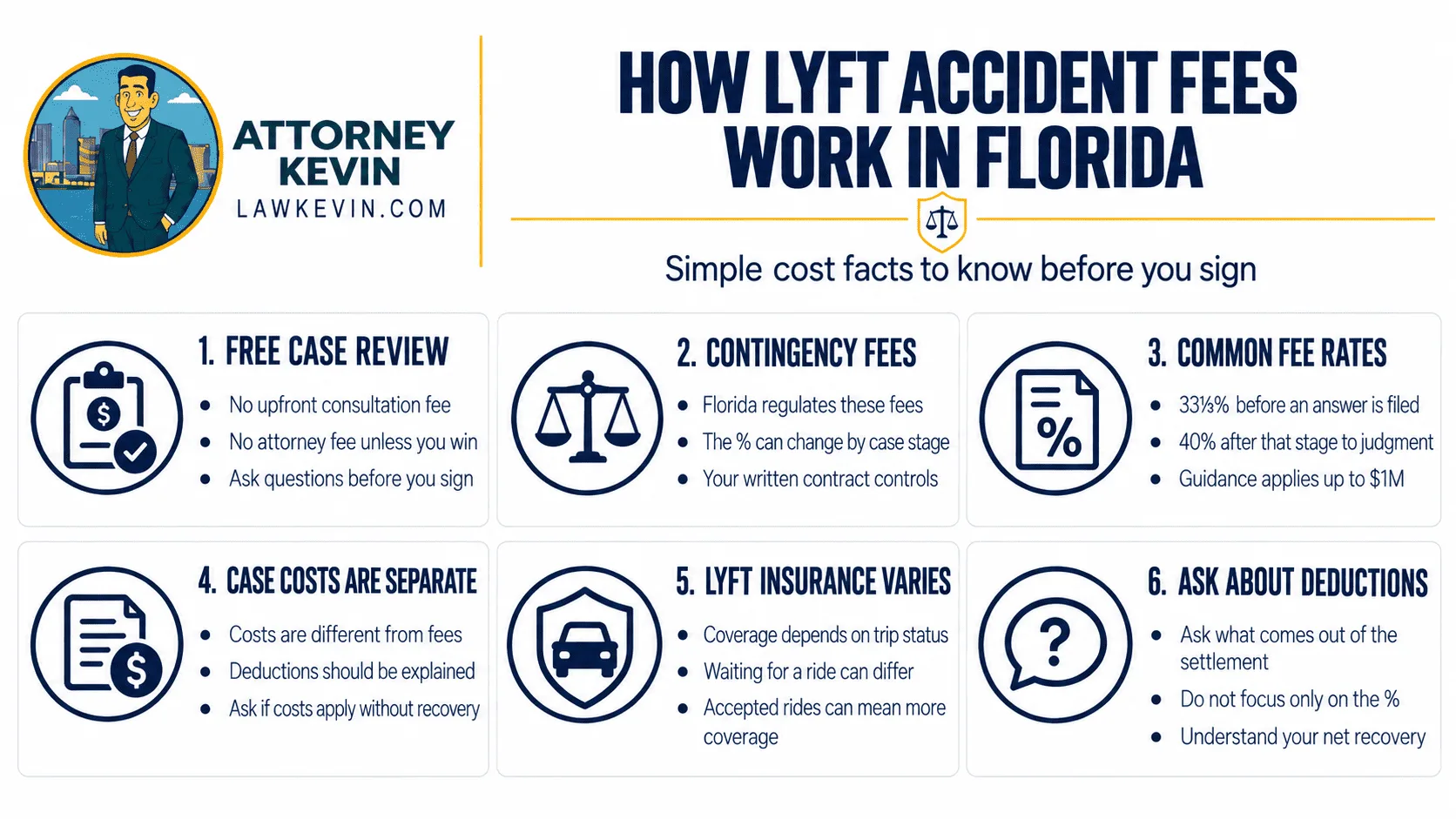
Hiring a Lyft Accident Attorney in Florida usually does not require an upfront attorney fee when the lawyer works on contingency. Instead of charging by the hour, the attorney receives an agreed percentage of the financial recovery if the case succeeds.
At Law Kevin, we make the initial step straightforward. Attorney Kevin L. Sullivan II offers a free, no-obligation consultation and states that attorney’s fees are charged only if he wins for you. If he does not win, you owe him no attorney fee.
That does not mean every contingency-fee agreement is identical. The percentage may depend on when the case resolves, and attorney fees are separate from case expenses such as filing fees, records, depositions, or expert costs. Florida requires contingency agreements to spell out how fees and expenses will be handled.
This article provides general information about Florida personal-injury fee arrangements. The written agreement for your individual case controls.
Key Takeaways
- A Lyft accident case can usually be evaluated without paying an upfront consultation fee, and Attorney Kevin charges no attorney fee unless he wins for you.
- Florida personal-injury contingency fees are regulated, and the percentage can change depending on when the case resolves.
- For recoveries up to $1 million, Florida Bar guidance generally identifies 33⅓% before a defendant files an answer or the applicable answer period expires, and 40% after that stage through judgment, subject to the written agreement and applicable rules.
- Case expenses are different from attorney fees. Your contract should explain which expenses may be deducted and whether you could owe costs if there is no recovery.
- Lyft accident claims can involve different insurance coverage depending on whether the driver was waiting for a ride request or had already accepted a ride.
- Ask what will be deducted from a settlement before focusing only on the contingency percentage.
Get a Free Consultation
Call us at (813) 598-4868
How Much Does a Lyft Accident Attorney Cost in Florida?
For many Florida Lyft injury cases, the attorney works on a contingency fee, which means the fee is calculated as an agreed percentage of the money recovered rather than an hourly bill.
Florida Bar consumer guidance states that, for personal-injury cases involving tort claims, a fee of more than the following amounts is generally presumed excessive without the required court approval:
| Stage of Case | Florida Contingency-Fee Guideline for Recovery Up to $1 Million |
| Before an answer is filed or the applicable answer period expires | Up to 33⅓% |
| After that point through entry of judgment | Up to 40% |
For portions of a recovery above $1 million, different percentages apply. Florida also has separate provisions for circumstances such as cases where defendants admit liability and dispute only damages or when post-judgment or appellate work becomes necessary.
These percentages are not a rule saying every attorney must charge that amount.
The Florida Bar expressly states that you and your lawyer can agree to a lower percentage, and a contingency agreement must be in writing.
That is why the right question is not simply, “Do Lyft lawyers charge one-third?”
Ask:
What percentage applies to my case, when can that percentage change, and what other deductions may come out of the recovery?
Does Attorney Kevin Charge an Upfront Fee?
Attorney Kevin advertises a free, no-obligation consultation and no attorney’s fee unless he wins for you. His website states that if he does not win, you owe him no attorney fee.
That means you can discuss the circumstances of the Lyft crash and whether he may be able to help without first paying an hourly consultation charge.
Attorney Kevin also provides clients with his direct cell phone number and handles communications with insurance companies so clients can focus on their medical recovery.
For questions about a Florida Lyft accident, you can call (813) 598-4868.
How Does a Contingency Fee Work?
A contingency fee ties the lawyer’s compensation to the outcome of the case.
Instead of receiving a bill for every phone call, letter, negotiation, or hour of legal work, the attorney receives the percentage described in the written agreement if money is recovered.
Consider a simplified example.
Suppose a case resolves for $90,000 and the agreed attorney fee at that stage is 33⅓%.
The attorney fee would be approximately $30,000.
That does not necessarily mean the client receives the remaining $60,000 as a final check. There may also be case expenses or other lawful deductions that need to be resolved.
That distinction is one of the most important things to understand before hiring a lawyer.
Attorney Fees and Case Costs Are Not the Same Thing
An attorney fee pays for the lawyer’s legal services.
A case cost is money spent to investigate, prepare, or litigate the claim.
The Florida Bar gives examples such as:
- Court filing fees
- Expert-witness expenses
- Copying or records charges
- Travel expenses
- Other litigation-related costs
The Bar explains that a contingency agreement must state what expenses will be deducted from the recovery and how those deductions will be calculated.
In a Lyft accident case, expenses could potentially involve medical records, crash evidence, depositions, court reporters, expert analysis, or filing fees if the case proceeds into litigation.
Not every claim generates substantial expenses.
A case that resolves through insurance negotiations may have a very different cost structure from one involving disputed liability, serious injuries, multiple defendants, expert witnesses, and trial preparation.
Do You Owe Case Costs if the Lyft Case Is Lost?
Do not assume that “no attorney fee unless we win” automatically answers this question.
Florida Bar guidance specifically distinguishes attorney fees from costs. It states that a client may still be responsible for case costs when there is no recovery unless the written contract says otherwise.
Attorney Kevin’s website verifies that you owe no attorney fee if he does not win for you.
Before signing any representation agreement, ask separately:
“If there is no recovery, will I personally owe any case expenses?”
The answer should be clear from the written agreement.
Does the Lawyer’s Percentage Increase if a Lawsuit Is Filed?
It can, but the important Florida dividing point is more specific than simply “before lawsuit versus after lawsuit.”
Florida Bar guidance says that for personal-injury recoveries up to $1 million, 33⅓% applies within the rule’s earlier stage—generally before the filing of an answer, demand for appointment of arbitrators, or expiration of the applicable time to do so. The corresponding limit generally increases to 40% after that point through entry of judgment.
That distinction matters because some online explanations oversimplify the rule as:
33⅓% before a lawsuit and 40% after a lawsuit.
That is not exactly how Florida’s rule is structured.
Your contract should explain what percentages apply and what event causes the fee to change.
Can You Negotiate a Contingency Fee?
Yes.
Florida Bar guidance expressly tells clients there is no legal requirement that every lawyer charge one set percentage. Clients have the right to discuss the proposed fee and negotiate the percentage.
Whether a particular attorney agrees to a different fee is another matter.
Factors that may affect the discussion include:
- Complexity of the claim
- Expected litigation
- Number of responsible parties
- Amount and quality of available insurance
- Severity of injuries
- Liability disputes
- Amount of investigation required
- Anticipated case expenses
The most important thing is knowing the terms before representation begins.
Your Florida Contingency Agreement Must Be in Writing
Florida requires contingency-fee agreements to be written.
The contract should explain the percentage or percentages used to calculate the lawyer’s fee, litigation and other expenses that may be deducted, and how those deductions are made.
Florida’s Statement of Client’s Rights also gives a prospective personal-injury client three business days to reconsider a contingency-fee agreement. A client can cancel in writing during that period without owing an attorney fee for the work performed during those three days, although actual costs reasonably incurred can still be an issue.
Read the agreement.
Do not rely solely on a percentage mentioned during a phone conversation.
Why Can Lyft Accident Claims Be More Complicated Than Ordinary Car Accident Claims?
A Lyft crash can involve an additional question that does not arise in many ordinary collisions:
What was the Lyft driver’s app status at the time of the crash?
That can affect which insurance requirements apply.
Under Florida’s 2026 transportation network company statute, different insurance requirements apply depending on what the driver was doing.
Driver Is Logged In but Has Not Accepted a Ride
When a Florida rideshare driver is logged into the digital network but is not engaged in a prearranged ride, Florida requires at least:
- $50,000 bodily injury coverage per person
- $100,000 bodily injury coverage per incident
- $25,000 property damage coverage
The statute also requires applicable PIP and uninsured/underinsured motorist coverage.
Lyft’s current insurance information describes the same basic $50,000/$100,000/$25,000 third-party liability levels when its app is on and the driver is available for requests, subject to Lyft’s stated coverage conditions.
Driver Has Accepted a Ride
Florida defines a prearranged ride as beginning when the driver accepts the request and continuing until the last rider exits the vehicle.
During that period, Florida requires at least $1 million in primary automobile liability coverage for death, bodily injury, and property damage.
Lyft likewise states that in most markets it maintains at least $1 million in third-party liability coverage while a driver is en route to pick up passengers or during a ride, subject to market-specific terms and exceptions.
That coverage structure is one reason preserving evidence of the driver’s app status can matter.
Why Does Insurance Complexity Affect the Legal Work?
The attorney’s contingency percentage does not necessarily change simply because Lyft is involved.
What can change is the work required to identify applicable coverage and pursue the claim.
A Lyft accident may involve questions about:
- Whether the Lyft driver caused the crash
- Whether another driver shares responsibility
- The driver’s status in the Lyft app
- Lyft-related insurance coverage
- The driver’s personal auto policy
- Your own PIP or uninsured/underinsured motorist coverage
- Several injured people competing for available coverage
- Medical causation
- Future treatment
- Lost income
- Permanent limitations
- Whether an early settlement fairly accounts for ongoing injuries
A relatively straightforward claim may resolve through negotiation.
A disputed case involving serious injuries and several insurance policies can require substantially more investigation and litigation.
The contingency model means the client generally does not receive an hourly bill every time that workload increases. The attorney’s compensation remains tied to the recovery under the agreed fee contract.
What Happens to Medical Bills if You Receive a Settlement?
Attorney fees are only one potential deduction from a personal-injury recovery.
Depending on the circumstances, medical providers, insurers, government benefit programs, or others may assert valid reimbursement or lien interests.
That means this equation is often too simple:
Settlement − attorney fee = client’s final payment
A more useful conceptual calculation is:
Gross recovery − attorney fee − applicable case expenses − valid medical or reimbursement obligations = net client recovery
The exact calculation depends on the individual case.
Ask your lawyer how medical bills and possible reimbursement claims will be addressed before the claim is resolved.
What Does a $100,000 Lyft Settlement Look Like After Attorney Fees?
Consider a hypothetical $100,000 recovery in a Florida case that resolves at a stage where the written contingency agreement provides for a 33⅓% attorney fee.
The calculation would begin roughly like this:
| Item | Example |
| Gross recovery | $100,000 |
| 33⅓% attorney fee | About $33,333 |
| Remaining before other deductions | About $66,667 |
| Case expenses | Depends on the case |
| Medical/reimbursement obligations | Depends on the case |
| Final net recovery | Depends on all deductions |
This is only an illustration.
It is not a prediction of what any Lyft case is worth, what Attorney Kevin would charge in a particular case, or what a particular client would receive.
The written representation agreement and actual case circumstances control.
Should You Choose the Lawyer With the Lowest Contingency Fee?
The fee percentage is important, but it should not be the only factor.
A lower fee does not necessarily result in a higher net recovery if the case is not investigated, documented, negotiated, or litigated effectively.
At the same time, a higher percentage should not simply be assumed to provide better representation.
Look at the whole attorney-client relationship.
Questions worth asking include:
- Who will personally handle my case?
- Will I be able to communicate directly with the attorney?
- What percentage applies?
- When can the percentage increase?
- How are case costs handled?
- What happens to costs if there is no recovery?
- Who negotiates medical or reimbursement obligations?
- Has the attorney handled rideshare claims?
- What happens if the insurer disputes the Lyft driver’s app status?
- Will I receive an itemized breakdown when the case ends?
Attorney Kevin tells clients they will receive his direct cell phone number, and his website states that he personally prioritizes keeping clients informed throughout the claim.
Is Hiring a Lyft Accident Attorney Worth the Contingency Fee?
That depends on the facts and complexity of the individual claim.
A minor crash with clear liability, limited treatment, and no insurance disagreement presents a different decision from a case involving surgery, lost income, permanent injury, contested fault, or several possible insurance policies.
The more useful question is:
What will the attorney actually handle that you would otherwise need to handle yourself?
Depending on the case, that may include:
- Investigating liability
- Preserving evidence
- Determining rideshare app status
- Identifying applicable insurance
- Communicating with insurers
- Obtaining records
- Documenting injuries and losses
- Evaluating settlement offers
- Addressing disputed medical causation
- Negotiating the claim
- Filing a lawsuit when appropriate
- Preparing the case for trial
At Law Kevin, Attorney Kevin tells clients that he deals with the insurance companies so they can focus on getting healthy.
Questions to Ask About Fees Before Hiring a Lyft Accident Attorney
Do not stop after asking whether the consultation is free.
Before signing, ask:
- What contingency percentage applies to my case?
- What event causes that percentage to change?
- How are case expenses handled?
- Do I owe expenses if there is no recovery?
- Are expenses deducted before or after the attorney fee is calculated?
- Could an appeal or post-judgment work result in an additional fee?
- How will medical bills, liens, or reimbursement claims affect my net recovery?
- Will I receive an itemized settlement statement before funds are distributed?
The Florida Bar specifically recommends discussing fees and related costs at the beginning of the attorney-client relationship so there are fewer surprises later.
Get a Free Consultation
Call us at (813) 598-4868

Know the Cost Before You Sign
Hiring a Lyft Accident Attorney does not have to mean writing a large check before your case begins.
With a contingency arrangement, the attorney’s fee comes from a successful recovery according to the written agreement. But you should still understand the percentage, when it may change, how case expenses are handled, and what other deductions could affect your final recovery.
At Law Kevin, we offer a free, no-obligation consultation, and Attorney Kevin charges no attorney fee unless he wins for you. He handles the insurance companies while you focus on getting healthy and gives clients his direct cell number so they can reach him with questions about their claims.
If you were injured in a Lyft accident in Florida and want to discuss the potential cost of representation and the facts of your claim, call Attorney Kevin L. Sullivan II at 813) 598-4868.
Frequently Asked Questions
Q: Do I have to pay a Lyft Accident Attorney upfront?
A: Not necessarily. Many personal-injury attorneys use contingency fees instead of charging upfront hourly fees. Attorney Kevin offers a free consultation and states that he charges no attorney’s fee unless he wins for you.
Q: What percentage does a Florida Lyft accident lawyer take?
A: The percentage depends on the written agreement and stage of the claim. Florida Bar guidance generally allows up to 33⅓% of the first $1 million at the earlier stage specified by the rule and 40% after the later procedural point through judgment, with different percentages applying to portions of larger recoveries and certain other situations. Lawyers and clients may agree to lower percentages.
Q: Is 33⅓% required by Florida law?
A: No. Florida does not require every personal-injury lawyer to charge 33⅓%. The Florida Bar states that clients may discuss and bargain over the proposed fee. The percentage must be stated in the written contingency contract.
Q: Do attorney fees include court costs and expert fees?
A: Not automatically. Attorney fees and case costs are separate. Your written agreement should state what expenses can be deducted, how they are calculated, and whether you may owe them if the case does not result in a recovery.
Q: Does Lyft have $1 million in insurance for every accident?
A: No. Coverage depends on the driver’s status. Under Florida law, the $1 million primary liability requirement applies while the driver is engaged in a prearranged ride, which begins when the driver accepts a ride request and continues until the last rider exits. Lower statutory limits apply when the driver is logged in but has not accepted a ride.
Q: What if another driver caused the accident instead of my Lyft driver?
A: The applicable claim and insurance sources can change when another motorist caused or contributed to the crash. Liability, available coverage, and possible uninsured or underinsured motorist issues need to be evaluated from the actual facts.
Q: What happens if the lawyer does not recover money for me?
A: Attorney Kevin states that if he does not win for you, you owe him no attorney fee. The treatment of separate case expenses should be confirmed in the written representation agreement.
Q: Can I cancel a Florida contingency-fee agreement after signing it?
A: Florida’s Statement of Client’s Rights provides a three-business-day reconsideration period for contingency agreements. A client may cancel in writing during that period without owing an attorney fee for work during those three days, although actual costs advanced can still matter.
Get a Free Consultation
Call us at (813) 598-4868
5720 Gall Boulevard, Ste 4
Zephyrhills, FL 33542
27642 Cashford Cir, Suite #110
Wesley Chapel*, FL 33544
5006 Trouble Creek Rd, Ste 205
Port Richey*, FL 33652
Sorry, the comment form is closed at this time.